



From Capitalism to Corporatocracy
27 December 2025
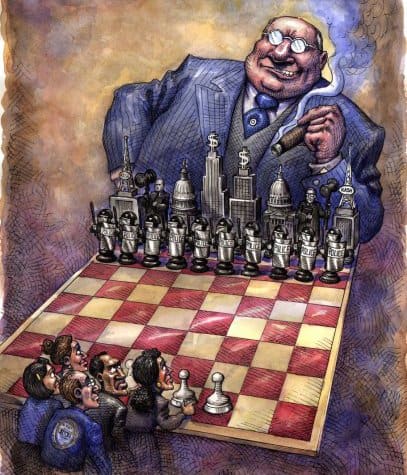
Once, in the human imagination, the world was vast—almost infinite. Its end was nowhere in sight, and the imagination filled it with astonishing images. Distant and frightening, shrouded in myths and legends, immersed in the fog of the unknown, lying beyond mountains, seas, and oceans inhabited by all kinds of creatures and unimaginable monsters, bordering the dark abyss of infinity…
Over the millennia, this world gradually began to shrink. Monsters and demons became endangered species, slowly retreating from the realms of human imagination, driven away by the cold light of rationalism and science.
The last few centuries have marked the triumph of science and progress. Roads and railways were built to the ends of the earth—now merely dull, empty places far from “civilization”—where they connected with other roads and railways, eventually wrapping the globe in a unified transport and information network. The romantic image of the world gave way to a rational and prosaic one. The world became a territory to be exploited.
The rise of capitalism followed, along with its myths: that everyone has a chance, as long as they are hardworking and enterprising. Western civilization entered a period of political, industrial, and cultural expansion. The era of corporations began. Corporations were legally defined, granted rights similar to those of individuals, and began to live lives of their own, guided by predatory logics and rules oriented toward ever-greater growth—much like insatiable monsters from mythology. In the “communist” East, this corporate monster was the state itself.
Almost imperceptibly, the world shrank to the size of a “global village.” It can now be traversed in a single day. The symbols of multinational corporations shine in nearly every city, proclaiming the character of a new, unified, and monopolized world. But their expansion has gradually slowed. Markets are saturated, and new markets, territories, and resources for exploitation seem either nonexistent or not particularly promising. After all, under capitalism not everyone can be a customer; some remain at the bottom of the consumer pyramid. They are merely production resources. In fact, most people are.
Left without territories to conquer, capitalism looked upward, toward the sky—only to realize it could not reach it. Technology and resources were insufficient, and dreams of space colonies or empires found expression only in science fiction novels and films. The sky remained high. Turning planets and stars into new fields of expansion was postponed to an undefined future—perhaps forever. Capitalism, genetically programmed for infinite growth, appeared condemned to live on a small, finite Earth.
And then it turned inward.
The direction of expansion shifted inward. Capitalism began to consume itself, transforming into corporatocracy. By its very nature, big business devours small business, and giant corporations become the absolute rulers of the supposedly free market, their power threatened only by the hesitant regulations of increasingly compliant governments. States are undermined and captured from within, while democracy turns into a hollow façade, ever more poorly concealing the dictates of elites and corporations.
Corporate power gradually extends not only over economies, but over every other aspect of social life. Yet corporate magnates and technocrats are neither statesmen nor philosophers. They do not distinguish between a state and a corporation. And so, the state itself becomes a corporation.
No comments yet. Be the first!