



The Hybrid Swamp
4 January 2026
Back in the 1970s, Stanisław Lem predicted that a time would come when the line between war and peace would become blurred and unclear. A time that would be neither war nor peace, but somehow both at once. Today, that time has arrived. We call it hybrid war.
This term refers to a broad spectrum of coordinated actions across different fields—military, informational, digital, political, social, psychological, and others—aimed at achieving a specific goal. This “evolution” in the concept of warfare is based not only on traditional military thinking, but also on insights from the humanities and information sciences, which expand military strategy through knowledge of human psychology and social interaction. In doing so, however, a Pandora’s box was opened. On the wings of science, new demons entered society—the demons of power over the human mind.
For those in power, the temptation of vast yet invisible control over individuals and societies is simply too strong to be restrained by moral or cultural considerations. When society is viewed as a project, a construction site, or a mechanism, the ordinary person is reduced to material—a bolt in the machine. For the socio-economic machine to run smoothly, it does not need fully developed individuals, but well-polished human bolts, stripped of anything unnecessary that might reduce efficiency in the role assigned to them.
Achieving this requires tools for imposing specific cultural norms and behavioral patterns, so that the system functions with minimal friction against human nature. This is where psychology and sociology come into play, in a toxic combination with rapidly advancing information technologies. In fact, it is precisely the accelerated development of computer science that has revived dystopian dreams of absolute global order. A covert and undeclared war for control and submission is thus waged against ordinary people, using all the achievements of modern science as weapons.
In various research centers and institutions, countless techniques are developed for suggestion, influence, or outright programming of the individual—reducing them to nothing more than a functional biological unit, an element in a dystopian socio-economic machine. Not all of these practices remain hidden. From time to time, scandals erupt, briefly illuminating the grim picture of total manipulation based on scientific advances in certain fields. Soon after, however, these scandals fade, sink back into obscurity, and gradually disappear from public discourse. And yet, digital manipulation scandals are only the tip of the iceberg. How deep it really goes, we can only guess.
Some psychological techniques, however, escape the shadowy world of institutions and agencies and become popular among the general public. Neuro-Linguistic Programming (NLP), for example, is openly taught as a tool for achieving various goals. Such techniques are more commonly used in educated social circles, but understanding of their mechanisms is slowly spreading throughout society as a whole.
Feeding the conscious and subconscious mind with messages can be used for self-improvement—but also for influencing the behavior, thoughts, perceptions, and decisions of others. Neutral by nature, these techniques can serve both positive and negative purposes, especially under conditions of intense social competition.
The mass adoption of such psychological technologies changes the nature of communication, personal attitudes, and society itself. In a world where words can act as invisible poisoned arrows, vigilance increases and suspicion becomes a default setting for those familiar with these methods. People begin to watch for a “25th frame” hidden between words or lines, anxious not to become “the dumbest person in the room.” Communication becomes more ambiguous and “hybrid,” relying heavily on metaphors, hints, and suggestion. Discussion and debate are replaced by manipulation. Morality and values are instrumentalized, distorted, and turned into tools.
Trust disappears—both in the “system” and in one another—while cynicism rises. As the system tries to program everyone, conditions drift toward a situation in which everyone tries to program everyone else. Armed with new psychological and social techniques, people use them chaotically, damaging not only culture but also the natural human relationships that support social cohesion and stability. The natural is gradually replaced by the artificial. Autonomy and self-organization are replaced by “projects.” Projects that must generate profit, repay investments, and produce dividends.
Public discourse sinks into a hybrid swamp, followed closely by interpersonal relationships. In this swamp, everything is unclear and blurred. Words lose their specificity and can carry multiple, even contradictory meanings depending on context. It becomes a matter of associations. In the spirit of general fluidity, meanings can also shift over time.
Like in an alchemical laboratory, everything is subject to experimentation. Concepts are mixed and recombined, embedded within one another like Trojan horses, relativized. Good blends with evil, morality with corruption, truth with lies, facts with fiction, sweet with salty—opposites packaged in a form that is easier to swallow, often garnished with a bit of “values” to help them go down. Truth and morality themselves become relative, a matter of perspective. The reference points of normality disappear, and life continues in fog and uncertainty, where it makes little sense to look too far ahead—it is more practical simply to orient oneself in the immediate surroundings.
In such a society, meaning and intention are often hidden between the lines. Information resonates with personal traits and guides the associations that assemble the message. Sometimes this happens unconsciously, as a vague feeling or attitude. Other times, suggestion is blunt and repetitive—brute force conditioning, hammered in until it breaks through. Keywords, images, songs, recommendations, advertising—the options are endless.
One of the more complex tools for influence, structuring, and maintaining the status quo is theater—staging. It can operate at many levels, from national politics down to the dynamics of a small company. This naturally leads to layered performances, theater within theater. The play never truly ends—one production simply flows into another, depending on circumstances. Multiple performances often overlap. The actors are also the audience; those who influence are simultaneously influenced.
This is how things (don’t) happen. Everything is artificial, but that is simply the reality. In this reality, everything is fluid and relative—even the individual, who liquefies in order to pour into prepared molds and be shaped as needed. Even morality becomes fluid, just another step in the dance of thesis and antithesis on the stage of public discourse. A dance that captivates the mass audience, tapping its foot to the rhythm.
Behind the scenes, however, the play looks different. There, another performance is unfolding. The scriptwriters know what they’re doing—or at least pretend they do. It’s complicated, and competition exists even among them. But regardless of everything, “the show must go on.” The actors give their all in this spectacle of absurdity, performing their hollow roles in a hypnotic trance of automatism.
In the end, the drive for predictability, control, and the programming of social processes leads to excessive complexity and an impossible knot of overlapping performances. At the same time, information about elite intentions and methods leaks into society, leading to their application at lower levels for private interests. All of this makes the system more expensive, less efficient, and more risky, while crises become more frequent. Uncertainty increases—for both rulers and the ruled.
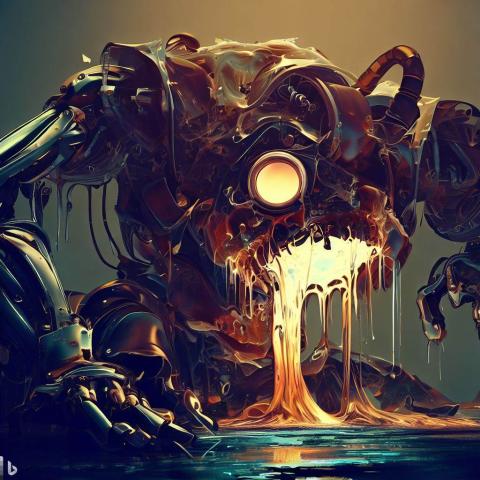
In short, attempts to program individuals and society in defiance of human nature and the rule of law do not lead to order, but to chaos. The socio-economic machine, overcomplicated to the point of absurdity and increasingly poorly assembled, begins to fall apart—or rather, to melt.
No comments yet. Be the first!