



The Alchemy of Ideas
4 January 2026

No one can say with certainty how the human brain works, and it is unlikely that this will ever be fully clarified. Scientific research, however, has identified certain patterns that are also confirmed outside laboratory conditions, in real life. Naturally, the functioning of the human brain lies far beyond the scope of this book, but mentioning some general principles is nevertheless necessary as a preparation for its core subject—namely, how thought and consciousness can be influenced (and indeed are influenced), as well as emotions.
At any given moment, our senses register a multitude of events and conditions, but not all of them reach conscious awareness. The brain has the capacity to consciously process only a limited number of simultaneous events (perhaps between five and nine). A large portion of the remaining stimuli is simply ignored, while another portion enters the subconscious without being consciously perceived at the time. Some of these fragments of information quickly sink into oblivion and disappear, while others remain, ready to resurface from the subconscious into consciousness when the brain has more time to process the sensory input.
Most of this information stays in consciousness only briefly, as it is not essential to us. Another part, however, remains permanently and becomes associatively linked with various memory structures, potentially influencing broader ideas and concepts that shape both our consciousness and subconscious. In this way, different psychological processes are affected, including judgment and decision-making.
The factors determining which information remains in our memory and which does not are complex, but an important one is our emotional state at the moment we receive the information. This is what we refer to as “imprinting.”
All of this is normal and logical, since human consciousness is a product of its environment. This means that we are shaped—consciously and unconsciously—by our impressions and experiences accumulated over time. Our thoughts, ideas, insights, and inspirations are also, to a large extent, products of the “incoming information” we absorb.
Archimedes famously shouted “Eureka!” after noticing something while bathing that led him to the realization that:
Any body immersed in a fluid experiences an upward force equal to the weight of the displaced fluid.
This is what we now call Archimedes’ Principle.
In other words, Archimedes needed a small external trigger to push his thought process toward a conclusion he had long been seeking. Because his consciousness was already “tuned” to a specific problem, his attention became more selective and filtered from the surrounding world precisely the information needed to complete the puzzle and solve it. The new input generated a unifying idea that synchronized his previous thoughts and observations into a single principle—Archimedes’ Law.
This example illustrates inspiration as the result of a conscious search for a solution. Even when not fully conscious, this search is directed by a mind that has already defined the problem. This is how slow, logical thinking works. But in other cases, everything happens far more subtly.
Intuition sometimes—though not always—represents unconscious heuristic generalizations based on information that may be conscious or unconscious. These generalizations influence our attitudes, perceptions, preferences, inclinations, decisions, biases, and behavior. The nature of the information that penetrates the subconscious affects intuition. When the information is misleading, biased, or limited—and this fact is not consciously recognized—it generates subconscious attitudes and perceptions that, in turn, shape behavior and life choices. This is the principle behind manipulation through suggestion. Psychoanalysis, conversely, seeks precisely these conscious or unconscious attitudes that shape both our inner world and our external reality, as well as our problems and faulty judgments.
All of this can be summed up by the exclamation of a person seeking help for inner struggles—something I once heard from an acquaintance:
“What kind of lie have I believed?”
There are themes and ideas to which individuals are more sensitive than to others. Everyone has different interests, imprints, problems, addictions, obsessions, fears, and so on. Based on these, incoming information is filtered—we decide what interests us and what does not, what inspires us, irritates us, frightens us, or leaves us indifferent. The accumulation of these themes and data in human consciousness shapes our self-image, our relationship with the world, and our inclinations and preferences, whether conscious or subconscious. Sometimes, this also determines our intuition.
It is possible for certain information—phrases, images, or words—addressed to the right person, with the appropriate psychological profile, at the right moment and in a specific situation, to prove decisive. They may act as a “virus” that, once it finds a weak point without defenses, spreads and exerts a defining influence on the psyche. I will illustrate this idea with an anecdote which, even if not based on a true story, reveals the vulnerability of the human mind.
In a psychiatric hospital, there once was a paranoid patient named Dancho who, after many years of treatment, showed significant improvement and was considered cured. Before his discharge, a final examination was conducted. Everything went well—until, just before the end, one of the doctors whispered to him:
“Dancho, we are watching you…”
After that remark, Dancho remained in the psychiatric hospital for the rest of his life.
Not very funny, is it?
Our ideas, beliefs, impressions, decisions, and intuitions can be—and are—influenced by our environment. We construct our own reality from countless conscious and unconscious “bricks” of information, and the ability to select and analyze them determines the nature of that reality.
Every object in the reality we observe is refracted through the prism of individual consciousness and becomes the subject of personal associations unique to each individual. This determines the emotional, intellectual, and spiritual resonance of reality within us, making it unique. A large, branching oak tree, for example, may awaken nostalgic childhood memories in one person—memories of evenings spent by a fire beneath a similar oak—while for another, it may evoke painful recollections of a motorcycle accident involving a tree like it. In this hypothetical scenario, the same oak triggers entirely different emotions and associations.
In another situation, one person may see in a tree the majestic calm of centuries of history, an entire microcosm of life, while another sees nothing more than raw timber.
This is why the poet William Blake was right when he said:
“The fool does not see the same tree that the wise man sees.”
We decode sensory information about the world based on our own experience, ideas, personal traits, and social position. In this way, we recognize the world and construct our individual reality. A simple example may help convince the reader.
Look at the image below. What do you see?
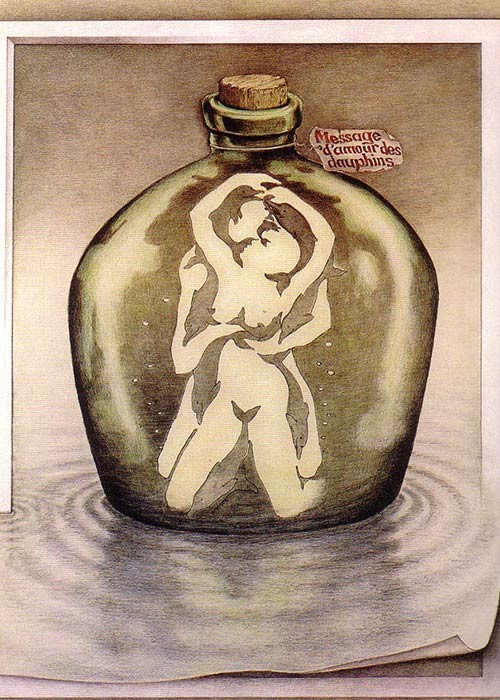
You probably saw a man and a woman.
But did you see the dolphins? Perhaps you did. If not, look again—there are at least nine dolphins in dark shades in the image.
Interestingly, young children who look at this image see only the dolphins and do not recognize the man and woman. They have not yet reached the stage of sexual maturity that influences how adults perceive the world.
This experiment shows how consciousness connects information about the world based on experience, inclinations, biases, ideas, and attitudes. We process not only visual information this way, but all kinds of information. This is how we orient ourselves in situations, analyze them, invent solutions, and act. And we most certainly do not see the whole picture.
Can something—or someone—influence how we perceive a situation, how we “see” it?
Of course.
Think about this the next time you are searching for a solution to a problem. Has something influenced your judgment? Are you considering all possible solutions? Do you see the whole picture?
Do you see the dolphins?
No comments yet. Be the first!