



High-Tech Clubs of the New Age
4 January 2026
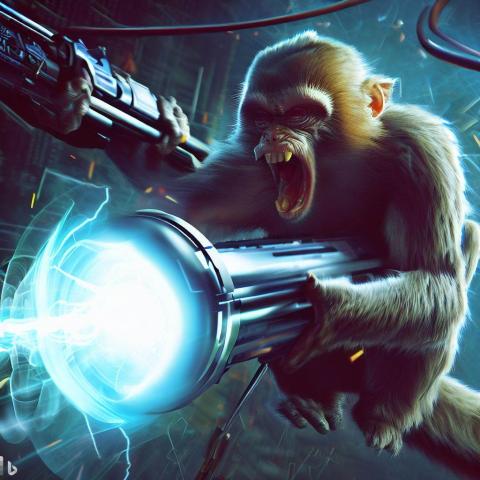
Artificial intelligence is advancing, greeted with both hope and fear. No one really knows whether it will make human life easier, enslave people, or simply become yet another tool in the arsenal of corporations and the so-called deep state for controlling humanity. Its developers—and those standing behind them—try to reassure us, claiming that AI is just a tool meant to benefit people by increasing productivity and expanding human capabilities.
AI can speak multiple languages, write texts, program, generate images, compose music. It can do many other things—and will be able to do much more in the future. Much more. What the average user sees today is only a minimalist preview of capabilities we can hardly even imagine. The real question is: is this a good thing or not?
Since the beginning of the Industrial Revolution, technological progress has been placed on a pedestal, treated as both a goal and a compass for societal development. Gradually, it turned into an end in itself. But the forces driving progress have always been profit and power—not ideals of universal human well-being or development. It is unlikely that corporations have suddenly experienced a wave of altruism that motivates them to deploy AI purely for the good of humanity. They are undoubtedly pursuing their own interests.
As for the first consequences of opening AI to public access, they are not particularly positive. Contrary to the cheerful optimism of enthusiastic technocrats, we are already witnessing the first layoffs caused by artificial intelligence—and more will follow. Most professionals engaged in intellectual labor have reason to feel threatened. It is widely predicted that AI will soon surpass human intelligence across all metrics, pushing skilled workers out of the labor market. Onto the street. Or into the fields—until even tomato pickers are replaced by robots.
For example, Elon Musk has predicted that the price of robots produced by his companies will drop tenfold within the next two or three years. All of this could destabilize labor markets worldwide, push societies into chaos, and force states to their knees before the corporations that control AI and robotics.
And then what?
Logic suggests the emergence of some form of corporate techno-totalitarianism or neo-feudalism, in which humans would have value only as livestock—because they would no longer have anything meaningful to offer. Their labor and talents would lose all value. In this way, elites could elegantly acquire total power over humanity, using technological progress as the means to achieve unlimited control.
But what would they do with such power? What fate would they assign to ordinary people, and in which direction would they steer evolution, once the wheel is entirely in their hands? We cannot know. Perhaps even the elites themselves don’t know—and likely don’t agree among themselves.
For now, the most plausible vision resembles those found in many science-fiction novels and films: islands of luxury and wealth surrounded by seas of misery. People who see themselves as gods would live concentrated in zones of staggering comfort, opportunity, and excess—absorbed in their own grandeur, culturally and emotionally detached from the rest of the population. That population would be controlled through technology and treated like cattle.
Over time, the rich and privileged would need the rest of humanity less and less. With automation and AI, even exploitation would lose its economic meaning—perhaps even its psychological appeal. After all, the pleasure of power is proportional to the perceived importance of those over whom it is exercised. It is one thing to dominate a worthy former rival; it is quite another to rule over someone seen as insignificant. A self-sufficient caste—or even race—of ultra-wealthy individuals, enabled by AI and automation, would likely have little interest in the rest of humanity. Two worlds would emerge, with the world of the unprivileged slowly losing its functions.
But would the other world be one of eternal prosperity and harmony? Would some form of true communism emerge—the very ideal so fiercely condemned by today’s elites? I doubt it. The same drive for power that would split the world in two would also divide the world of the “winners” of progress. There would still be struggles for dominance, intrigue, and conflict—just as we see today in every country and on the international stage.
It seems that, for better or worse, this is human nature—or rather, the current stage of our evolutionary development. Which leads to a sobering conclusion: technological progress will not solve any fundamental human problem as long as human development is still largely governed by instincts of power and domination. On the contrary, progress will generate new problems—not because it is inherently “bad,” but because it is driven and wielded by a level of human consciousness and culture that does not match its power.
Today, progress increasingly resembles… a club from the Stone Age.
Only far more efficient, destructive, and devastating.
No comments yet. Be the first!