



Economy (Exploitation, Stress, Misery, and Control)
2 January 2026
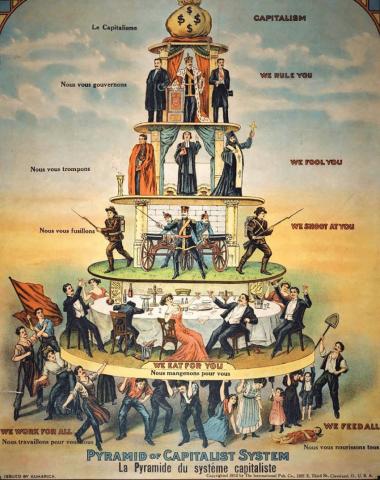
The economy is the most important factor shaping the life of the individual and of society as a whole. Its character and structure determine the type of society we live in and its values, social attitudes, processes, culture, lifestyle, opportunities, the health status of the population, and much more.
However, the economy is neither democratic nor fair.
Increasingly, in line with the global concentration of capital, the supposedly “free” market is shaped by a small number of monopolies and cartels. These actors not only dictate market conditions but also steer society itself—through both overt and covert mechanisms. Ordinary people are left with little choice but to adapt and submit to ever more stressful business demands and ever more unequal labor compensation.
Small businesses are steadily losing ground, suffocated by corporations and monopolies—and the middle class is shrinking along with them. Working conditions are becoming increasingly stressful and demanding, working hours are growing, while rising prices outpace wage growth. This is the real effect of so-called “economic freedom”: the freedom of the big players to devour the small ones and impose their conditions on entire societies.
While the middle class is shrinking worldwide, a new class is expanding. This class is known as the precariat. These are people who lack security, predictability, and stability—in both income and social status. Their livelihoods are defined by uncertainty; they often have no permanent jobs and work on a piecemeal basis, never sure when or whether the next engagement will come. This deeply affects both their lifestyle and their psychological well-being. They live day to day, month to month.
In 1997, Alan Greenspan—then Chairman of the U.S. Federal Reserve—openly described the emergence of the precariat as a deliberate policy aimed at economic success through the creation of “greater insecurity for the worker.” By pushing people into insecurity, stress, and misery, U.S. oligarchic elites pursued greater economic power and control.
Indeed, despite the antisocial and inhumane conditions under which this class lives, large business circles consider the precariat useful for the economy. It produces a workforce that is undemanding and willing to accept almost any working conditions, thereby reducing labor costs, expenses for improving working environments, and social benefits.
At the same time, political stability for the system is ensured. People locked in a desperate struggle for physical survival simply do not have the time, energy, resources, or mental space to organize and fight the system for social justice or demand a better life. Living in degrading conditions, they pose no real threat—unless someone manages to organize them. And the system takes care that such a person does not emerge. In the “best” case, it will fabricate one—someone who channels anger and resentment into a safe, controllable direction, while creating the illusion of real representation within the structures of power.
The fact is that workers across the world are increasingly forced to accept deteriorating working conditions that generate more stress and consume ever larger portions of their time. In the United States, for example, much of the unskilled workforce has no fixed working hours and can be called in at any moment—often based on algorithmic calculations. Holding two or even three jobs has become entirely normal, simply to make ends meet.
This places individuals under constant psychological and physical stress and makes it almost impossible to escape this degrading, day-to-day survival mode.
The imposed lifestyle of living on credit further enslaves the average individual, making escape from this vicious cycle nearly impossible—unless one wins the lottery or robs a bank. People often purchase goods and services on credit not out of greed or irresponsibility, but out of necessity. This includes housing, cars, and—in most countries—education and healthcare.
Paradoxically, all of this is happening during the greatest period of labor automation in human history. Instead of automation reducing working hours and distributing work more evenly, we see stress and working time continually increasing, alongside a growing army of precariat workers and unemployed people.
In theory, mechanization should improve conditions for everyone, shorten the workday, and support the comprehensive development of individuals and society. Instead, we observe the exact opposite—because automation has become a priority not for society, but for corporations.
As early as 1932, the philosopher and scientist Bertrand Russell argued in his now-famous (and then equally controversial) essay In Praise of Idleness that even at the level of science and industrialization in Britain at that time, a four-hour workday was entirely possible and highly desirable for a balanced life and the development of both individuals and society. Yet nearly a century later, the discussion is no longer about reducing working hours—but about unemployment.
In countries like the United States, working hours continue to rise, approaching levels found even in parts of the so-called Third World.
Despite industrialization and scientific progress, advancement has become a private affair. The current global condition is the result of a deliberate plan and the imposition of an ideology aimed at keeping the masses trapped in everyday survival, misery, and insecurity—so that they can be more easily controlled.
In the era of robotization, the issue is no longer merely exploitation.
It is power.
No comments yet. Be the first!