



Sex… and Control
2 January 2026

It is a fact that sexual instincts and predispositions motivate a large portion of human behavior. They also belong to the most basic needs in Abraham Maslow’s hierarchy of needs.
Everyone knows who Sigmund Freud is. The name of the Austrian psychologist has become synonymous with the connection between unconscious impulses, sexual instincts, and human behavior (and dysfunction). Many of his ideas are still considered relevant today. The partial taboo surrounding sex in Western culture leads not only to various neuroses, but also opens the door to controlling individuals through techniques that activate and manipulate sexual drives.
As a light example, consider a scene from an American film in which one colleague tells another that he is about to get married. When the second colleague makes an ironic remark about the shackles of marriage, the future groom replies that marriage also has its advantages—such as the possibility of regular sex.
Looked at beyond its comedic tone, the scene hints at something deeper: the use of basic needs and instincts to steer socially desirable behavior—in this case, forming a family and having children. But techniques for working with sexual “programming” are not mastered only by clever young women looking for a “loving” husband and associating sex with marriage, commitment, responsibility, and parenthood. They are equally well mastered by advertising agencies, PR specialists, politicians, and others.
This is because the emotions triggered by sexual instincts can be linked to almost anything. Sex can be associated with products that sellers want us to buy. It is no coincidence that sex sells everything today: laundry detergent, coffee, alcohol, power drills, cars, banking services, insurance, leadership positions, political candidates—literally everything. Everything can be connected to sex and thus become a partial subconscious substitute for it.
The stronger the sexual impulse in a person (or the greater the frustration), the more powerful this associative mechanism becomes. The tabooing of sex, or the presence of cultural and social barriers around it, increases neurotic tension and susceptibility to sexual manipulation. In some individuals who cannot satisfy this need, sublimation occurs: sexual energy is redirected toward another activity—often work—into which the person immerses themselves intensely.
To illustrate sublimation, here’s a humorous joke:
Someone was asked whether his job satisfies him.
He replied: “Yes, it does.”
Asked why, he said:
“In the morning, when I go to work, I feel like having sex.
In the evening, when I come back from work, I don’t anymore.
Therefore, my job satisfies me.”
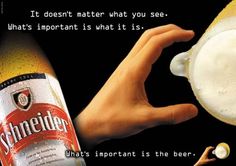
Examples of sexual manipulation are most visible in advertising. The following cases hardly need any commentary at all…









No comments yet. Be the first!