



At the Base of Maslow’s Pyramid…
26 December 2025
Today, the individual is quietly subjected to a covert disabling of consciousness and a form of submission achieved through psychological programming techniques, social methodologies, legal mechanisms, social infiltration, cultural diversion, media manipulation, and even controlled criminality—organized crime as a tool of pressure. Economic oppression is real: job insecurity, low wages combined with high costs of rent, transportation, and services place the majority of people in a chronic state of stress. Contributing to this stress are working conditions that demand excessive productivity, the restrictive character of corporate culture and workplace relations, intense competition, and long working hours. In the West, an ever-growing part of the population—though less often literally hungry—lives under economic insecurity. A full life is obstructed by financial barriers, while securing housing or a dignified old age (and in some places, even healthcare and education) absorbs most of these people’s energy and effort.
As difficult as all this is to endure, people’s values and expectations are gradually rewritten: what was once unthinkable is now accepted as normal, while what used to be normal is labeled “utopia,” “communism,” “far-left extremism,” and so on. The message is: there is no alternative. Expectations are lowered—slowly and systematically—from striving for self-realization to merely striving for security. Often, one step off the career track, one wrong move, can mean slipping into the swamp of marginalization, from which escape is rare.
It becomes increasingly obvious that a deliberately managed psychological weakness—instability, depression, demotivation—is part of an elite strategy for governing society and individuals.
According to political analyst and executive director of the Albanian Media Institute, Remzi Lani, the repressive regimes of Eastern Europe have today been replaced by depressive regimes. But these depressive regimes are hardly a monopoly of “the East.” They certainly exist in the West as well—perhaps in a more concealed and refined form.
What does all this do to the individual’s consciousness?
Very simply: it shrinks. It contracts down to the level of the environment and the conditions in which the person exists. Higher needs and capacities fail to unfold. The individual remains stuck in “survival mode.”
This is exactly what Abraham Maslow’s hierarchy of needs helps explain.

Maslow’s Pyramid of Needs
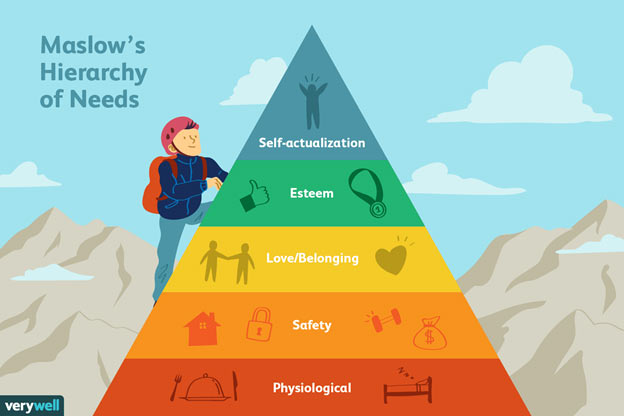
Maslow’s Pyramid (the “Hierarchy of Needs”) is a model consisting of five successive levels. It is usually visualized as a pyramid: the five levels rise from bottom to top, while the width of each level represents how widespread those needs are across the population. At the base are the physiological and existential needs—food, sleep, shelter, safety. Since life is impossible without them, they concern essentially everyone and therefore form the broad foundation. Higher needs appear in the lives of fewer people, so they occupy narrower levels above. At the top are the highest needs, realized by relatively few. According to some interpretations and popular summaries, only around 2% of people reach the final level.
The five levels are:
- Physiological needs
- Safety needs
- Love and belonging
- Esteem, recognition, respect
- Self-actualization and self-determination
A key point in this theory is that needs from a higher level do not meaningfully emerge—let alone become satisfied—if the needs below them remain unmet. Put simply: you don’t philosophize well on an empty stomach.
Keeping people at the bottom
As we can see, deteriorating conditions across much of the world keep masses of people trapped in the lower tiers of Maslow’s pyramid. For most, life becomes a continuous attempt to cover basic needs, without the time, energy, freedom, or inner space to pursue growth at a higher level. That makes people easier to control and manipulate, easier to exploit—and less able to organize collectively in defense of their interests.
And if those conditions are still not enough to keep someone near the bottom, there are many techniques that can push them downward. Almost anyone can be driven into states of depression and emotional suppression—into a diminished life in which they miss opportunities for full living and self-realization. And this is not only about mass fears promoted by governments—terrorism, epidemics, and so on. The weakening of the individual, the planting of complexes and low self-esteem, is also carried out through culture, media, and advertising—through the broader processes of society and business.
The goal is to compress the person’s consciousness into the stereotype of the “average” individual—because that stereotype implies a mind living at the lower levels of Maslow’s pyramid. This stereotype denies the uniqueness of every individual and standardizes the person into the mass human being that the system requires.
Under such conditions, only a minority manage to realize their potential and reach the levels connected with self-actualization and self-determination.
And you?
Can you tell which level of Maslow’s hierarchy you’re living in right now?
No comments yet. Be the first!