



Society
2 January 2026
Social Construction or Social Engeneering(the real meaning)?
Society—or human society—is a large group of people, a community engaged in sustained social interaction, sharing the same geographical or social territory, subject to the same political authority and dominant cultural expectations. Sometimes the term also refers to society on a global scale—the “global society” as a whole. (Wikipedia)
Society has always been—and still is—a social pyramid. This is a fact we cannot ignore. Natural selection exists, as do biological and social inheritance. To a large extent, these factors determine one’s position within the social hierarchy. Of course, luck also plays a role—perhaps a greater one today than in the past, given the complexity and chaos of the modern world. But the factor we must not overlook is the socio-economic system and the dominant ideology, which profoundly shape the mechanisms of selection.
Corporatocracy, in its pursuit of “efficiency,” absolutizes certain factors deemed important for individual advancement while neglecting others. Among the neglected are the influence of environment, solidarity, compassion, empathy, and the sense of human—rather than ideological—community. These qualities are just as intrinsic to human beings as competition, ambition, and the drive for success. Evolution cultivated them for a reason: they are essential for the survival of social species.
It is precisely these traits that corporatocracy seeks to amputate from human culture—or to instrumentalize, distorting them so they serve technocratic ideology and goals. The objective is to reduce human interaction in every sphere of life to market relations, to transactions of value. The individual, possessing a market value of their own, is transformed into a product.
This market valuation is based on a fixed set of criteria that claim to fully describe a person, dismissing everything else—everything truly human—as irrational. The individual is treated as a finished product rather than a process capable of growth and self-actualization. Only once reduced to a product and a resource can the individual be fully integrated into the technocratic, (anti)social yet collectivist project—because no screw or cog in a machine can possess free will. Every part has a predefined function and must meet strict standards.
Viewing society as a machine inevitably leads to such a fate for human beings.
Social engineering takes on the task of placing each human “component” in its proper position and—using modern information technologies—polishing it to perfection, optimizing it for its designated function. In practice, this means shaping personal attitudes, values, life goals, desires, spiritual horizons, and interests, while imposing specific behavioral models.
Higher efficiency demands narrower specialization and more labor—even at the cost of producing one-sided individuals, the so-called “professional idiots.” For today’s system, this is not a flaw but a desired outcome, as it simplifies the control of the “human herd.”
Disciplines of psychological modeling, assisted by Big Data—the mass recording of human behavior via digital devices—take on this otherwise daunting task. On its own, such psychological programming might be limited in effectiveness, but today it is reinforced by increasing corporate control over every aspect of life, capital concentration, the growing antisocial nature of states, and the erosion of the middle class.
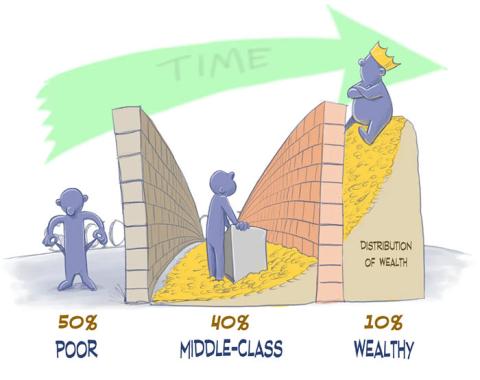
The result is a class-based—or even caste-based—society: a much steeper social pyramid with vast distances between base and summit, and invisible barriers between its levels. Despite claims of objectivity, an individual’s position often depends less on personal qualities than on systemic interests—applied covertly, with cold calculation, methodical cruelty, cynicism, and, when necessary, justified with arrogance and hypocrisy. Fortunately, justification is increasingly required, as global discontent grows.
In reality, success within the system depends first on loyalty, and only then on personal merit—contradicting the premise of social Darwinism, which claims that the most capable rise naturally in free competition. While social Darwinism is used rhetorically to justify inequality, the core method of corporatocracy—social engineering—directly contradicts it. In controlled societies, elites cultivate the social vanguard themselves, ensuring it never turns against its creators. Those who are inconvenient are suppressed by every available means.
History shows us that fascism repressed many brilliant minds because they did not conform to its values or myths. However vehemently modern authoritarians and “social engineers” deny their subjectivity, they cannot convince us that they act purely in “the interest of society.” Their obsession with “objectivity” and “facts” is always directed outward—never inward. This is the fundamental flaw of all authoritarian and totalitarian systems: power lacks a corrective, because elites are irreplaceable. Over time, errors and distortions accumulate—even if we imagine the impossible scenario of a system founded on absolute truth.
No ideology has ever been perfect, nor will one ever be. The same applies to people, who inevitably corrupt even the “purest” doctrines. It is unlikely that Jesus Christ ever imagined millions would be burned alive in his name. During those dark chapters of history, he must have been turning in his grave—or wherever one believes he resides.
As further illustration of human subjectivity and double standards, it is worth recalling that most Nazi leaders themselves failed to fit the Nazi racial ideal—a myth in itself—yet this did not stop them from exterminating others deemed “inferior.” Similarly, the Stanford Prison Experiment, conducted by Philip Zimbardo, demonstrated how people internalize social roles: the empowered come to believe they deserve power and repression, while the oppressed internalize submission.
When natural human social tendencies are suppressed or replaced by ideology, the imposed conditions distort the course of evolution itself. Society becomes merely a project—often an imperfect one. In trying to preserve itself against inevitable internal contradictions, such projects tend to degenerate into repression, fanaticism, and madness. The more rigid the project, the more extreme these tendencies become.
Because human nature is imperfect—and human lust for power persistent—democratic correction becomes essential. Democracy treats society as a dynamic process rather than a fixed design. Unsurprisingly, elites dislike this. As Winston Churchill famously observed:
“Democracy is the worst form of government—except for all the others.”
Naturally, corporatocratic society is not solidaristic. Genuine civil society can scarcely exist within it. Solidarity is confined within classes—most notably in the strong class consciousness of the wealthy and their awareness of antagonism toward the poor. Success is measured primarily by money and position within the hierarchy. It is an elitist metric.
Yet elites understand that eliminating solidarity entirely leads to atomization and nihilism, threatening systemic stability. Thus, while preaching unrestricted capitalism as individual freedom, they simultaneously demand obedience under the banner of “solidarity.” This is not social solidarity, but conformist collectivism—loyalty to the State, and by extension, to the elites who control it.
Here, the concept of solidarity is deliberately redefined. It no longer means human unity based on shared interests, but devotion to the state, its symbols, and the status quo. Those who resist this imperative are branded selfish, antisocial, or dangerous—while issues of social injustice and elite hypocrisy are conveniently ignored.
Conceptual manipulation, value redefinition, and double standards in favor of the wealthy lead to moral chaos and widespread cynicism. Values are instrumentalized until they lose meaning, generating a pervasive sense of falseness and growing nihilism. Still, the system continues to moralize, promote religiosity, invent new pseudo-religions, and mobilize citizens to solve problems that are fundamentally the state’s responsibility.
Some social problems are even deliberately left unresolved—or created—because mobilizing people around them provides a sense of purpose while safely channeling energy away from real structural change.
We are repeatedly told “There is no alternative”—a phrase popularized by Margaret Thatcher. Visions of a more just society are dismissed as utopian, decadent, dangerous, or perverse. Language itself is altered: society is replaced with community, a term implying narrower, hierarchical, “traditional” bonds. Society emphasizes rights; community emphasizes belonging and obedience.
In most countries, an invisible social network infiltrates institutions, politics, the economy, media, culture—every layer of society. This network is resilient because it is built on dependencies so costly to escape that “betrayal” becomes unthinkable. These dependencies may be financial, social, emotional, familial. Through this network, oligarchic control is exercised, stabilizing the system and steering social processes within elite-approved limits.
Capitalism and corporatocracy divide society into classes. Without such division, an elitist system could not function. Class separation is maintained through political, economic, legal, educational, psychological, and informational mechanisms. Inequality enables the strategy of divide and rule. Elites possess strong class consciousness and work tirelessly to prevent its emergence among lower classes, who remain fragmented and focused on individual survival.
Although class society is vigorously denied, the word “class” remains taboo in public discourse. Acknowledging it is labeled outdated, ideological, or a dangerous flirtation with communism. Yet class maintenance is a covert policy implemented through infiltration, dependency, and manipulation—ensuring the lower classes remain what Noam Chomsky called the “confused herd.”
As psychology advances, language is refined as a tool of manipulation. Through hints, insinuations, and coded speech, emotions, fears, anxieties, hopes, and hostilities are provoked. Trust erodes. Privacy disappears under surveillance and profiling. Communication becomes empty, flooded with digital noise. Isolation becomes the condition for control.
In line with divide-and-rule, individuals are forced into constant competition for resources, under rules imposed from above. Solidarity and humanity must be eliminated—unless instrumentalized to serve the system.
Eventually, no one trusts anyone. Social cohesion collapses. Trust falls below the critical threshold required for society to function.
The actions of elites confirm the words of Adam Smith:
“All for ourselves, and nothing for other people, seems, in every age of the world, to have been the vile maxim of the masters of mankind.”
No comments yet. Be the first!