



The Individual as a Project?
1 January 2026
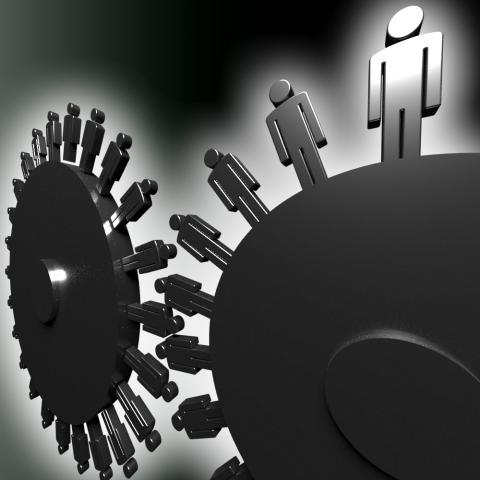
Broadly speaking, there are two main ways of understanding society. One views society as a mechanism or a machine; the other sees it as a process. The first perspective is more typical of conservative mindsets and of people with undemocratic or even fascist beliefs, while the second is more characteristic of those with liberal inclinations. The well-known British philosopher of Austrian origin Karl Popper, in his work The Open Society and Its Enemies, argues in favor of the latter view—that society is a process.
But if we examine society as a machine composed of separate parts, designed, built, and repaired, what then happens to the human being? Can a person exist as a self-determining and self-actualizing individual while simultaneously serving as a mere cog in that machine?
Every component in a machine is strictly specialized for a specific function and has a precisely defined place within the overall structure. All parts of the same type are fully standardized—there can be no random variations in size or shape. A nut cannot sometimes function as a bolt, nor can a bolt occasionally replace a spring. A machine composed of such “unique” parts could neither be designed nor function properly.
But what does this logic look like when applied to society as a machine, and to the human being as one of its components? Can we, as individuals, be treated like standardized nuts and bolts—fully shaped, classified, and assigned by function, regardless of our rights, desires, or aspirations? Even the Nazis and fascists did not fully reach this point, although they clearly moved in that direction. So far, such an order has existed only in dystopian literature—novels like 1984 by George Orwell, Fahrenheit 451 by Ray Bradbury, Brave New World by Aldous Huxley, and many other works, more or less well known, devoted to the relationship between the individual and the system. None of these novels depict happy worlds; they portray monstrous realities where order is enforced through violence, repression, brainwashing, and the molding of consciousness. In Huxley’s novel, happiness itself is artificially produced—through drugs.
Thus, in a world where society is reduced to a machine, everything down the chain—right to its smallest component, the individual—becomes subject to design and synchronization with the overarching project. Otherwise, the machine’s efficiency would decline, and energy not channeled into “useful” activity would generate friction, wearing the system down. In practice, this would mean imposing a socio-economic matrix that encompasses every aspect of social relations and life as a whole.
Such a social project would require strict differentiation of social strata and their internal homogenization—including culture and values—leading to the formation of classes or even castes. Contact between members of different classes would have to be minimized and limited strictly to what is necessary for the system’s functioning, in order to avoid unwanted social diffusion that might blur class boundaries and create moral and social complications. Family relationships would also need to be standardized and reduced to behavioral models, likely with variations depending on class. These relationships would be based on prescribed roles rather than on interactions between free individuals.
All communication in such a society would be expected to follow predefined protocols, so as not to disrupt the functioning of the social machine by generating ideas and processes deemed harmful to its efficiency. This would require totalitarian control over all spheres of life, along with the imposition of a rigid culture that sustains the entire social structure. Social engineering at its absolute maximum.
From this, we arrive at a stark conclusion: in the social machine, there is no place for the individual. The individual must “die” in order to become a project—a product modeled, programmed, and standardized according to a predetermined role. The inner world of the human being would be replaced by ideology; personal development and self-determination would be entirely denied. Morality, being too human and therefore obstructive to the machine’s operation, would also have to disappear or be replaced with suitable directives—likely differing for each caste, which would exist as separate worlds divided by barbed-wire walls.
This is the internal logic of a society that understands itself as a machine and strives for ever-greater efficiency and organization. A society modeled as a machine would be the ideal totalitarian state.
Yet life remains unpredictable and incalculable. Life is improvisation. The future is shaped by the butterfly effect, multiplied countless times in every single moment. Human beings will always long for freedom, development, choice, and the discovery of personal meaning. It may sound paradoxical, but life needs freedom in order to organize itself and to grow. Life, in any of its social forms, cannot be placed under the command of a single “super-brain” and its instruments.
It is no coincidence that thinkers such as Karl Popper and Friedrich Hayek arrived at the conclusion that:
Human life is not something that can be engineered.
The paradigm that treats society as a machine is ultimately fatal. Attempts to impose it will, over time, lead to increasing friction between the machine and human nature.
And yet, today, this social machine is being built at an accelerating pace—at every level.
No comments yet. Be the first!